



Choosing a Pressure Calibration Partner: What Matters When Compliance Is on the Line
A calibration certificate is often one of the last things an auditor reviews — and one of the first they question when something does not look right. For quality managers, laboratory managers, and instrumentation engineers, pressure calibration is more than a compliance requirement. It underpins product quality, operational safety, and audit readiness.
Many organisations select calibration providers on price, location, or accreditation status alone. Those factors matter, but they rarely determine whether a provider will respond effectively when an instrument fails, an auditor requests supporting evidence, or a production deadline depends on a rapid turnaround. The organisations that experience the fewest calibration-related disruptions tend to look beyond the certificate and focus on the quality of the partnership behind it.
Not All Accredited Calibration Laboratories Are Equal
ISO/IEC 17025 accreditation is the recognised benchmark for technical competence. But accreditation alone does not guarantee that a laboratory can support every pressure calibration requirement. Scope matters. A laboratory accredited for general pressure calibration may not hold the reference standards, manufacturer tooling, or documented procedures required to calibrate high-end instruments such as piston gauges, pressure controllers, or air data test sets.
When evaluating a provider, experienced metrology and quality professionals typically assess the following criteria.
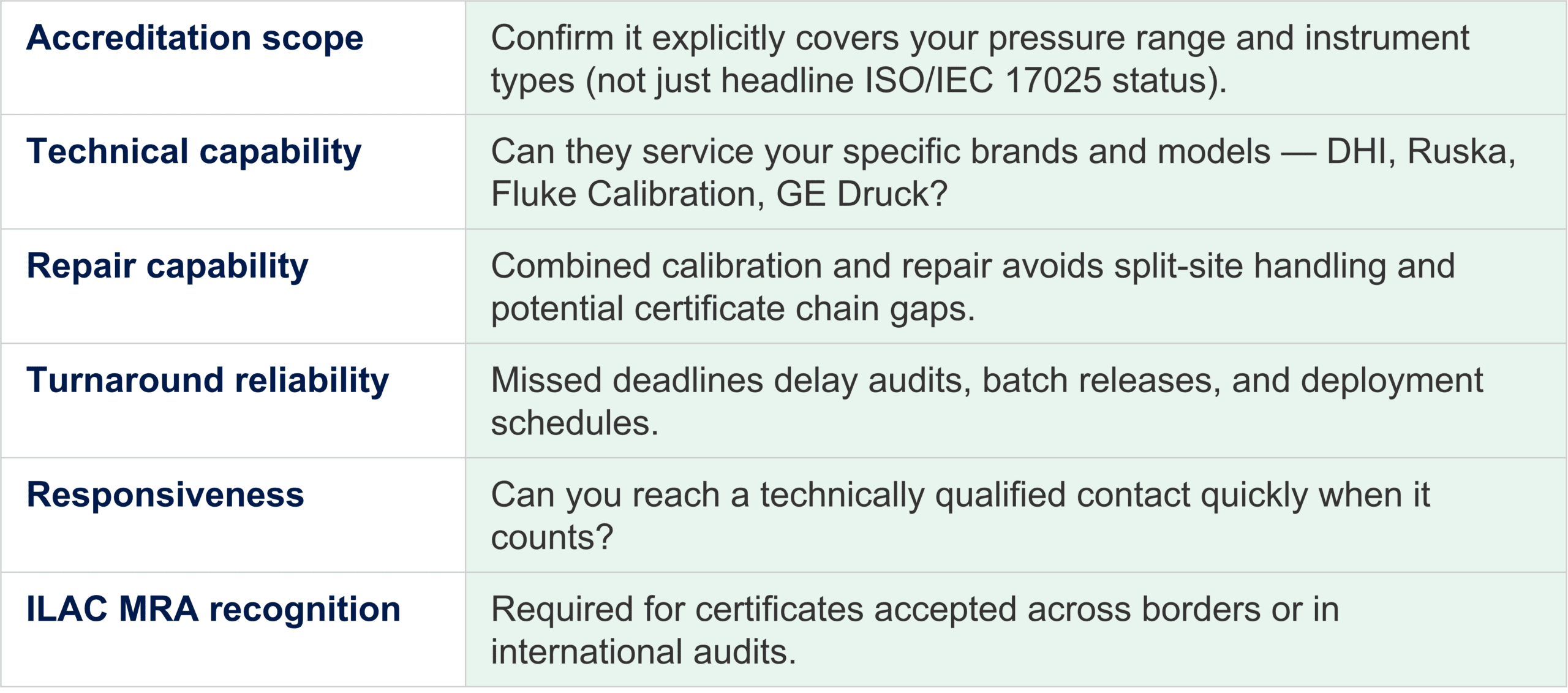
These factors become particularly significant when equipment is found out of specification, a critical instrument requires urgent repair, or traceability evidence is needed to support an external audit. In those situations, the difference between a supplier and a trusted calibration partner becomes clear.
Why Responsiveness Matters More Than Most Organisations Realise
Technical competence is expected. Responsiveness is what often determines whether a minor issue stays manageable or becomes an operational problem.
A delayed certificate can hold up a production release. An unanswered technical query can slow audit preparation. A critical instrument waiting weeks for repair creates costly downtime. For organisations in regulated sectors — aerospace, pharmaceuticals, defence, energy, oil and gas — these delays carry consequences well beyond the calibration laboratory. That is why leading organisations now evaluate providers not only on technical capability, but also on communication, service transparency, and speed of response when issues arise.
What Calibration Professionals Value Most
To understand what clients actually expect from a calibration partner, Minerva Metrology & Calibration conducted its 2026 Customer Satisfaction Survey across 90 clients. The results offer a clear view of the factors that drive long-term relationships.

More than half of new clients were referred by colleagues, engineers, and industry peers — recommendations earned through consistent delivery and technical credibility, not marketing.
An NPS of +58 remains well above the B2B professional services benchmark of +25 to +45, with 61% of respondents classified as promoters. The referral figure is particularly telling: in highly technical industries, peer recommendations are based on direct experience of service quality under pressure, not on promotional claims.
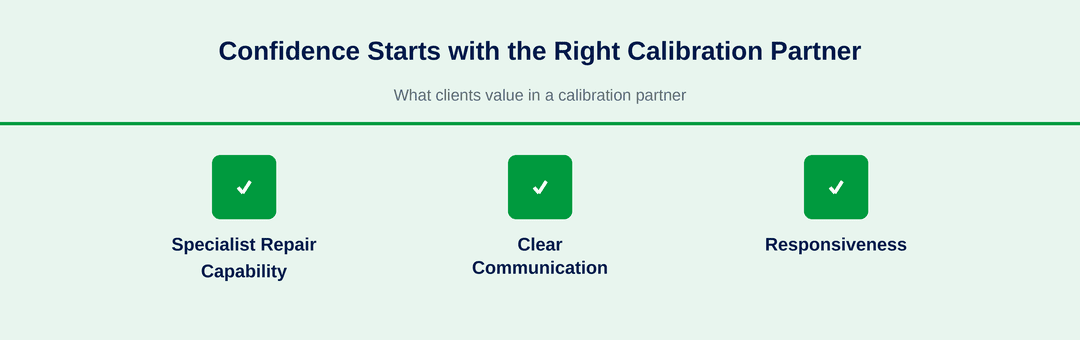
When asked why they chose Minerva, the most commonly cited reasons were specialist repair and maintenance capability (60% of respondents) and technical knowledge and experience (56%). Responsiveness was cited by 28% — a figure that reflects how operational this criterion has become for calibration-intensive organisations. Quality of work, knowledge, and customer service were the three most valued aspects overall.
Why Specialist Expertise Still Matters
Pressure calibration is a specialist discipline. It spans a wide range of instruments, pressure ranges — from vacuum to 5,000 bar — and applications, each with its own traceability and uncertainty requirements. For organisations managing piston gauges, pressure controllers, or critical process instrumentation, access to specialist knowledge reduces risk in ways that a general-purpose calibration laboratory cannot replicate.
Minerva Metrology & Calibration has maintained continuous RvA accreditation (K048) under ISO/IEC 17025 since 1988. As the Fluke Calibration Authorized Service Center for EMEA, Minerva provides manufacturer-level service for Fluke Calibration products across Europe, the Middle East, and Africa. Operating as part of NMi Group, clients also have access to broader testing, certification, and advisory capabilities when required, including audit preparation, uncertainty budgets, and calibration software implementation.
The Strongest Partnerships Reduce Risk
The best calibration partnerships are not defined by a single certificate or transaction. They are built on the confidence that when an audit approaches, an instrument fails, or a technical question arises, expert support is available without delay.
For organisations evaluating providers, the most useful question is not simply whether a laboratory can calibrate a specific instrument. It is whether the organisation behind it can support measurement and compliance objectives reliably — and respond effectively when the unexpected happens.
That distinction is what separates a calibration supplier from a calibration partner.
Reviewing your calibration programme?
Whether you're reviewing calibration providers, preparing for an audit, or looking to improve measurement traceability, a technical discussion can help identify opportunities to reduce risk, improve efficiency, and strengthen compliance confidence.
Contact the Minerva Metrology & Calibration team to discuss your pressure calibration requirements, repair needs, or broader metrology challenges.
Phone +(31)33 462 2000
E-mail sales@minerva-calibration.com
June 11, 2026